
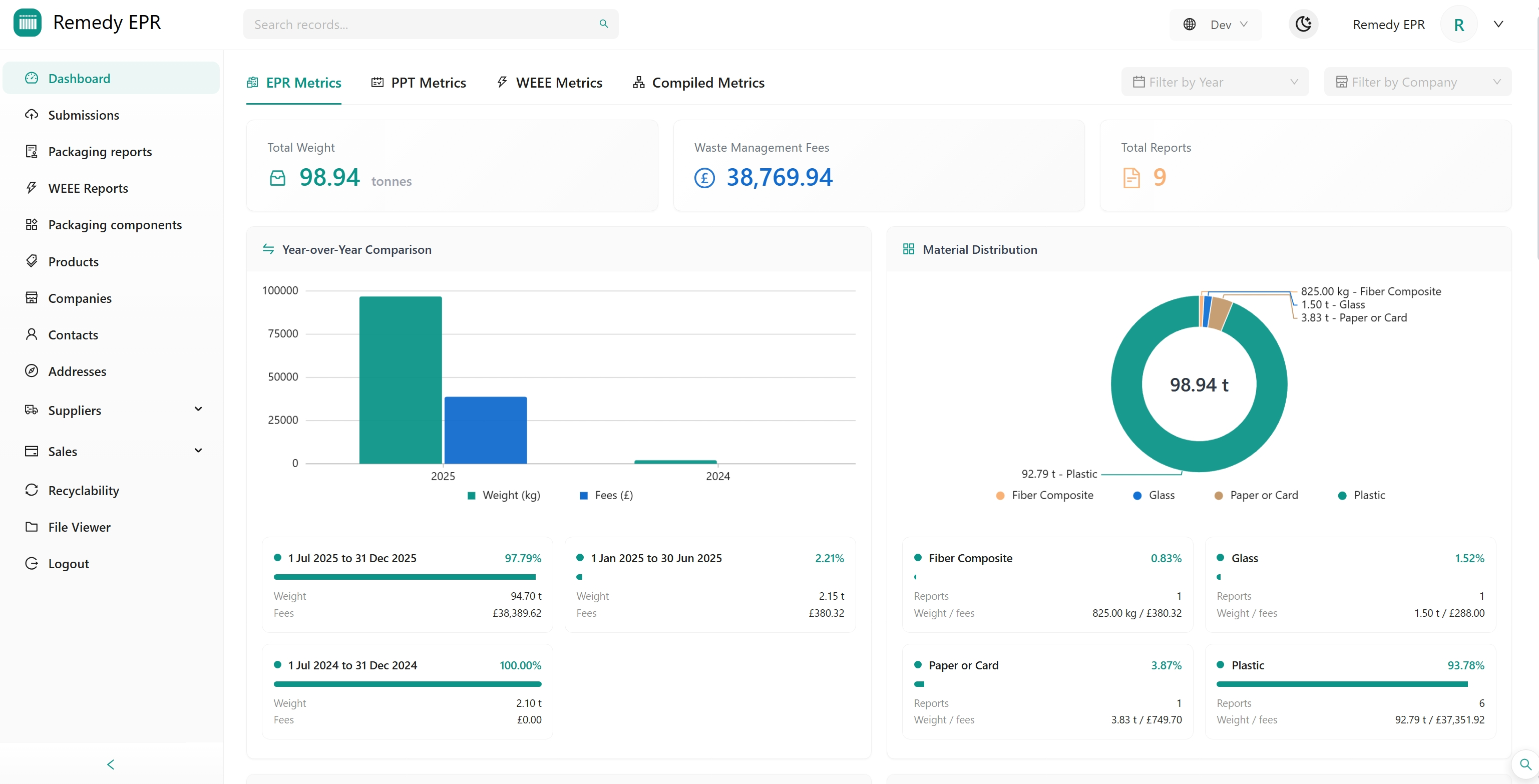
What EPR software actually does
Extended Producer Responsibility (EPR) makes the business that places packaging on a market pay for, and report on, what happens to it afterwards. EPR software is the system that holds your product and packaging data, applies each scheme's classification and fee rules, and produces the report and evidence a regulator or compliance scheme asks for.
At minimum, EPR software should store packaging at component level (material, weight and packaging type), link it to the units you sold in each market, and output a report in the format that market expects. The better products also keep a trail from every reported figure back to its source document, calculation and reviewer approval. That trail is what you need when an auditor, scheme or regulator queries a number.
Three types of EPR provider
"EPR software" is used for three quite different purchases. Most bad buying decisions come from comparing products in different categories as if they were the same thing.
| Type | What it is | What it does for you | Best when | Examples |
|---|---|---|---|---|
| EPR data and reporting platform | Software your team uses to manage packaging data and reports | Collects, validates and calculates data; prepares reports and evidence; you keep control | You want ownership of your data and want to reuse it across markets and regulations | Remedy EPR, Repax, PackTotal |
| Compliance scheme or managed service | A scheme or consultancy that takes on work, and sometimes obligations, for you | Registers, collects data, submits and may carry certain legal obligations | You have no internal packaging-data function and want it handled | Valpak, Ecoveritas |
| Enterprise regulatory suite | A broad platform covering many schemes, countries and product streams | Central view of packaging, WEEE, batteries and taxes across many entities | You are a multinational with a central compliance team and implementation budget | Lorax EPI, Sphera EC4P |
Decide which category you are buying before you book demos. A scheme and a software platform can both be the right answer, but for different businesses.
UK vs EU EPR: what the software has to handle
If you sell into more than one market, check that a product models each regime properly rather than relabelling one report.
UK packaging EPR
UK producers submit packaging data through Defra's Report Packaging Data (RPD) service. The software needs to handle packaging activities, household and non-household classification, nation of sale, and the Recyclability Assessment Methodology (RAM) red, amber and green ratings that drive modulated fees. Large producers report every six months; small producers report once a year. See the UK EPR reporting calendar for current deadlines.
EU packaging EPR
Each EU member state runs its own EPR system, with its own register, producer responsibility organisations, material categories and reporting cycle. Germany's LUCID register and France's unique identification number (UIN) are two well-known examples. The EU Packaging and Packaging Waste Regulation (PPWR) applies from 12 August 2026 and harmonises parts of this, including registration in each member state where you make packaging available and authorised representatives for producers established elsewhere. Country-level reporting still differs, so EU coverage needs to be checked country by country.
What this means for software
The data is largely shared: the same packaging components, weights and sales volumes drive every report. What changes is the mapping. Good EPR software keeps one product and packaging record and applies each market's categories, fee rules and output format to it. Read our PPWR compliance overview for how declarations of conformity fit in.
EPR software comparison table
| Product | Type | Best for | UK EPR | EU EPR | RAM / fees | Audit evidence | Supplier data |
|---|---|---|---|---|---|---|---|
| Remedy EPR | Data and reporting platform | Teams that want UK and EU reporting plus defensible evidence | Yes | Yes | Yes, scenario modelling | Strong: lineage, approvals, audit pack | Supplier requests and extraction |
| Repax | Data and reporting platform | Product-data-first teams, free tier | Yes | Yes | Yes | Audit-ready data trail | Product specification intake |
| PackTotal | On-premise software | Teams with IT resource that want a self-hosted database | Yes | UK-focused | EPR / PPT calculations | Document library; configuration dependent | Internal collection |
| Valpak | Compliance scheme | UK producers who want a managed scheme | Yes | UK-focused; ask about international | Scheme calculation | Scheme controls | Managed collection |
| Ecoveritas | Service + software | Brands with messy historical and supplier data | Yes | Confirm scope | Fee optimisation | Audit support | Service-led collection |
| Lorax EPI | Enterprise suite | Multinationals reporting in many countries | Yes | Yes, broad | Yes | Reporting controls | Varies by engagement |
| Sphera EC4P | Enterprise suite | Enterprises with packaging, WEEE and battery obligations | Yes | Yes, broad | Yes | Enterprise controls | Varies by module |
Based on public product information and the workflow each vendor describes as of November 2026. Capability, country coverage and pricing change. Test with your own data before signing.
The criteria that actually separate EPR software
Feature lists look similar across vendors. These are the questions that expose the real differences once your first modulated invoice or audit query arrives.
- Component-level data. Can it store each packaging component (material, weight, packaging type) per SKU, with the source document attached?
- Market coverage. Which countries does it report for today, not on the roadmap? Ask for a coverage list and a sample output for every market you sell into.
- Scheme-specific rules. Does it apply UK classifications and RAM, and each EU country's material categories, rather than one generic model?
- Fee modelling. Can it forecast fees and show the effect of a material or design change before you commit to it?
- Evidence trail. Can a second person trace any reported figure to its source, calculation, classification and approval, including what changed after filing?
- Supplier data. Does it reduce chasing suppliers for specifications, or just move the chasing into another portal?
- Integrations. Can it take product and sales data from your ERP, PIM, ecommerce platform or CSV exports without repeated manual joins?
- Submission handoff. Who submits: you, your scheme, an authorised representative, or the vendor? Who signs off?
- Data ownership and exit. Can you export everything, including evidence and history, if you leave?
- Pricing basis. Is it priced per SKU, per component, per country, per user, per tonne or flat? The basis matters more than the headline number as you grow.
Red flags when buying EPR software
- The demo only uses the vendor's sample data and never touches yours.
- "EU coverage" means a list of countries, but no one can show a real output for the countries you sell into.
- Fees are shown as a single total with no way to see how they were calculated.
- Editing a component weight silently overwrites a report you have already filed.
- The contract is unclear about who is responsible for submission and accuracy.
- No straightforward export of your data, evidence and version history.
- Supplier data collection is "supported" but in practice relies on emailing spreadsheets.
How we compared the products
We reviewed the workflow each vendor describes publicly and scored it against the criteria above, weighting evidence, market coverage and the submission handoff most heavily. Public websites do not prove implementation quality, so ask each vendor to process a representative sample from your catalogue, including a mixed-material pack and an incomplete supplier record.
Remedy EPR
Best fit: teams that want UK and EU EPR reporting, fee control and audit evidence together
Remedy EPR connects packaging data with EPR reporting, RAM assessments, fee calculations and audit evidence. It covers UK packaging EPR and EU EPR reporting from the same product and packaging record, so a business selling into the UK and EU member states maintains one set of packaging data rather than one spreadsheet per country. The same record also supports Plastic Packaging Tax, WEEE, PPWR declarations and digital product passport workflows.
Its main differentiator is the evidence chain. Each reported figure can be traced to the source document, packaging component, classification and reviewer approval. The platform keeps version history and can export an audit pack for a reporting period, which is more useful than a dashboard screenshot when a regulator or scheme asks how a number was built.
Remedy also handles supplier requests and document extraction, so packaging specifications and declarations can be collected and reviewed before they enter a report. Fee modelling shows the impact of material and design changes, including the 2026 UK modulated fee structure.
Where Remedy is the wrong choice: Remedy is software, not a compliance scheme. If you want someone else to take on the obligation and the submission entirely, a managed scheme is a better fit. If you have a handful of SKUs in one market, the free EPR calculator may be enough for now.
See Remedy EPR software · See the audit evidence workflow
Repax
Best fit: product-data-first teams selling in the UK and EU
Repax treats EPR as a product-data problem: specify a product and its packaging once, then generate the report each market expects. It has a free tier and low-cost paid plans, which makes it accessible to smaller producers and teams that want to own their data.
Its public product set covers UK EPR reporting, EU filing and PPWR declarations of conformity. That combination is attractive if your main pain is maintaining one product data layer across several markets.
Watch-outs: confirm the depth of UK scheme support, supplier collection and audit evidence for your route to market. If you want a scheme to take the obligation off your hands, that is a different buying decision.
PackTotal
Best fit: UK producers with IT resource who want an on-premise packaging database
PackTotal is a Windows application from Pentamid Ltd for recording packaging components, weights, material and sustainability information, with a document library for supporting evidence. It produces Plastic Packaging Tax and EPR reports, and supports nation of sale, brand ownership and self-managed waste collections.
The important difference is deployment. PackTotal is not a web-based SaaS product. You install it on your own server, either on-premise or in a cloud environment you control, with a Microsoft SQL Server database. That gives you complete ownership of commercially sensitive packaging data, but your IT team is responsible for hosting, database licences, backups, access and upgrades. The standard licence covers a single company and up to 15 users.
Watch-outs: there is no vendor-hosted browser workspace, so supplier and auditor collaboration is less self-serve, and the product is UK-focused. Ask for a demonstration of external evidence collection and the audit trail.
Valpak
Best fit: UK producers who want an established managed scheme
Valpak is one of the most established names in UK packaging compliance and is part of Reconomy. It runs a compliance scheme, so it registers members, manages packaging data and submits on their behalf. Its scale and longevity are the main draw.
For a team without an internal packaging-data function, a managed scheme can be the pragmatic choice. You are buying a relationship and a service, not just software.
Watch-outs: managed services can be expensive. Confirm data ownership, export rights and how much of the workflow you can see. A managed model can make it harder to reuse the same data for EU reporting, PPWR or a future scheme change.
Ecoveritas
Best fit: organisations with fragmented historical packaging data to clean up
Ecoveritas positions itself as a packaging data and analytics specialist. Its strongest use case is a messy data estate: fragmentary supplier records, legacy SKU information and inconsistent material data spread across several years.
In that scenario, the service can review records, flag anomalies and model alternative packaging or fee scenarios. That makes it useful for teams with large historical datasets and limited internal capacity, where the real problem is turning raw inputs into a reliable baseline.
Watch-outs: the model is service-led and can be less responsive for day-to-day operational changes than a dedicated reporting platform. Confirm what sits inside the service, which countries are covered and whether outputs are portable and auditable.
Lorax EPI
Best fit: international teams that need broad regulatory coverage
Lorax EPI provides software and regulatory services for packaging, WEEE, batteries and environmental taxes, with coverage across a large number of schemes worldwide. It is built for central compliance teams that need one view across many countries.
The trade-off is usually implementation effort and cost. A producer selling into the UK and a few EU countries may not need the breadth; a multinational with several product streams probably does.
Watch-outs: ask for a country coverage matrix, a sample UK RPD output and a clear split between software, consultancy and submission services.
Sphera EC4P
Best fit: enterprises managing packaging, WEEE and batteries across many schemes
Sphera EC4P is an enterprise platform for packaging, WEEE and battery obligations, covering registrations, reports, deadlines and fee payments across a large number of compliance schemes. It suits organisations with complex entities and multi-country product portfolios.
The breadth is real, but so is the implementation. Test the current UK reporting file, RAM evidence and the handoff to your scheme rather than assume enterprise coverage equals local depth.
Watch-outs: confirm which services sit outside the software fee and how much configuration your entity structure needs.
A step-by-step way to evaluate EPR software
- Decide the category. Software you run, a scheme that runs it for you, or an enterprise suite. Shortlist two or three in that category.
- List your markets. Write down every country you place packaging in and when each report is due. This becomes your coverage test.
- Pick a test sample. Choose 20 to 50 SKUs with mixed materials, shipment packaging and at least one incomplete supplier record.
- Run one real reporting period. Import a period of sales data and produce the UK file and at least one EU country report.
- Trace a figure. Ask a second user to trace a report line back to its source and approval.
- Change something. Edit a component weight and confirm the previous report is preserved and the change is logged.
- Check the exit. Export all data and evidence, and get the three-year cost and submission responsibilities in writing.
For a deeper checklist, see EPR audit evidence and fee accuracy, the UK EPR audit checklist and the free audit readiness score.
How much does EPR software cost?
Most vendors quote rather than publish a price, because cost depends on SKU count, number of countries, integrations, supplier collection and support. The subscription is only part of the total: implementation, data cleansing, manual review and audit response can exceed it. Scheme membership fees and the EPR fees themselves are separate again. To estimate UK packaging fees, use the free EPR fee calculator.
Ask for a three-year total cost, a clear data-export position and a written description of what the vendor does not do. That last question separates a reporting tool from a managed service faster than any feature matrix.
EPR software guides by use case
The right shortlist changes with how you sell. These guides go deeper for specific buyers:
- Best EPR software for ecommerce sellers: shipment packaging, Shopify and Amazon order data, and marketplace rules.
- Best EPR software for EU and multi-country sellers: national registers, PPWR, authorised representatives and multi-country platforms.
Questions buyers ask
What is the best EPR software?
There is no single best product for every producer. Remedy EPR is the strongest fit for teams that want UK and EU EPR reporting, RAM fee modelling, supplier data and audit evidence in one workflow. Repax suits product-data-first teams, PackTotal suits teams that want an on-premise database, Valpak suits UK producers who want a managed scheme, and Lorax EPI and Sphera EC4P suit large multinationals with many schemes.
What is EPR software?
EPR software stores product and packaging data, applies the classification and fee rules of each Extended Producer Responsibility scheme, and prepares the reports and evidence producers must provide. Good EPR software also shows how every reported figure was calculated and who approved it.
Which EPR software covers both UK and EU reporting?
Remedy EPR, Repax, Lorax EPI and Sphera EC4P all describe UK and EU coverage. Remedy EPR prepares UK packaging EPR and EU EPR reporting from the same product and packaging record, alongside PPWR declarations. Ask any vendor for a country coverage list and a sample output for each market you sell into.
Does EPR software submit reports to the regulator?
Not always. Some products prepare an export while the producer, authorised representative or compliance scheme completes the formal submission. Ask each vendor to demonstrate the exact handoff, including who approves the file and who retains the evidence.
Is EPR software the same as a compliance scheme?
No. A compliance scheme or producer responsibility organisation takes on certain producer obligations and submission activity. EPR software organises your data and evidence. Some schemes offer software and some software vendors offer filing services, so confirm which legal and operational responsibilities sit with each party.
How much does EPR software cost?
Pricing usually depends on SKU or component count, the number of countries, integrations and support. Budget for implementation, supplier data collection, manual review and audit response, not only the subscription. Ask for a three-year total cost and a clear data-export position.
Can one platform handle UK EPR, EU EPR and PPWR?
The data overlaps heavily. One product and packaging record can support UK EPR, EU country EPR reports and PPWR declarations, but material categories, fee rules, responsible operators and evidence differ by market. Confirm the vendor models those differences rather than relabelling one report.
Prepare accurate EPR reports without rebuilding spreadsheets
Remedy EPR automates data imports and calculations, detects compliance errors and keeps evidence ready for review.
Research sources: public product pages from Remedy EPR, Repax, PackTotal, Valpak, Ecoveritas, Lorax EPI and Sphera EC4P. Regulatory background: GOV.UK packaging EPR guidance and Regulation (EU) 2025/40 (PPWR). Confirm product status, pricing and country coverage with each supplier.
Disclosure: Remedy EPR publishes this comparison and appears in it. The ranking reflects the criteria in this article and is not an independent audit. Regulatory details are for orientation, not legal advice.